
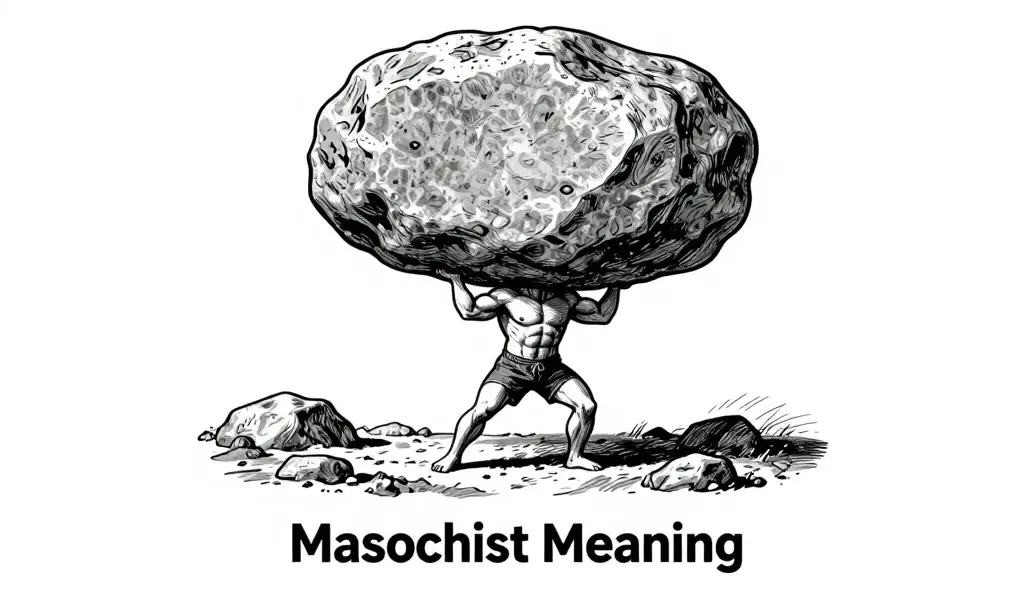
The term masochist is often used in everyday conversations, psychology discussions, and internet culture.
You may have heard someone jokingly say, “I’m a masochist for doing this,” after taking on a difficult task or enduring an unpleasant experience.
However, the word has a more specific meaning and history than many people realize.
The masochist meaning generally refers to a person who derives pleasure, satisfaction, or enjoyment from experiences that involve discomfort, hardship, or pain.
Depending on the context, the term can be used literally, psychologically, or humorously.
This guide explains the complete meaning of masochist, its origin, psychological definition, examples, common uses, and misconceptions.
What Does Masochist Mean?
A masochist is:
A person who gains pleasure, satisfaction, or gratification from experiencing pain, discomfort, hardship, or humiliation.
The word can be used in both serious psychological contexts and casual everyday conversations.
Simple Definition
A masochist is someone who enjoys or willingly accepts experiences that most people find unpleasant.
Masochist Meaning in Everyday Language
In casual speech, people often use “masochist” humorously.
Examples
- “You’re running a marathon in this heat? You must be a masochist.”
- “I keep watching sad movies. I’m such a masochist.”
- “Anyone who enjoys working weekends is a masochist.”
In these examples, the term doesn’t literally mean the person enjoys pain. Instead, it jokingly suggests they willingly choose difficult or uncomfortable experiences.
Masochist Meaning in Psychology
In psychology, masochism refers to deriving pleasure or emotional satisfaction from pain, discomfort, or humiliation.
Psychologists distinguish between:
Physical Masochism
Enjoyment of physical discomfort or pain.
Emotional Masochism
Seeking situations that involve emotional suffering, rejection, or self-sacrifice.
It’s important to note that psychological concepts are more complex than everyday slang and may involve various motivations and behaviors.
Origin of the Word Masochist
The term comes from the name of Austrian writer:
Leopold von Sacher-Masoch
His writings often explored themes involving pleasure and suffering.
In the late 19th century, psychiatrist Richard von Krafft-Ebing coined the term masochism based on Sacher-Masoch’s work.
Since then, the word has become part of both psychological and everyday vocabulary.
Masochist vs Masochism
These terms are related but different.
Masochist
A person who exhibits masochistic tendencies.
Masochism
The behavior, trait, or concept itself.
Example:
- She is a masochist.
- Her behavior demonstrates masochism.
Signs Commonly Associated with Masochistic Tendencies
Depending on context, people may:
- Seek difficult challenges
- Endure discomfort willingly
- Find satisfaction in sacrifice
- Prefer demanding situations
- Tolerate hardship more than others
However, enjoying challenges alone does not automatically make someone a masochist in the psychological sense.
Masochist Meaning in Relationships
The term is sometimes used when discussing relationships.
Examples may include:
- Repeatedly pursuing unhealthy relationships
- Accepting unnecessary emotional suffering
- Remaining in difficult situations despite alternatives
However, relationship dynamics are complex and should not be oversimplified using labels alone.
Masochist Meaning in Internet Slang
Online, “masochist” is frequently used as a joke.
Examples
- “I chose the hardest difficulty setting. I’m a masochist.”
- “I checked my work email on vacation. Total masochist move.”
- “I started another 12-hour project. Guess I’m a masochist.”
Here, the word usually means:
Someone willingly choosing a difficult or frustrating experience.
Difference Between Masochist and Sadist
These words are often confused.
Masochist
Enjoys experiencing pain, discomfort, or hardship.
Sadist
Enjoys causing pain, discomfort, or humiliation to others.
Quick Comparison
| Term | Meaning |
| Masochist | Enjoys receiving pain or hardship |
| Sadist | Enjoys inflicting pain or hardship |
They are opposite concepts.
Common Examples of Masochist Usage
Work
Working overtime every weekend? You’re a masochist.
Fitness
Training for an ultra-marathon sounds masochistic.
Entertainment
Watching heartbreaking movies repeatedly is a masochist’s hobby.
Gaming
Playing impossible games makes some people joke that they’re masochists.
Synonyms of Masochist
Depending on context:
- Self-punisher
- Sufferer
- Martyr (in some contexts)
- Self-sacrificing person
- Pain-seeker
No synonym perfectly captures the full meaning of masochist, but these terms may overlap.
Antonyms of Masochist
Opposite ideas include:
- Pleasure-seeker
- Comfort-seeker
- Hedonist
- Pain-avoider
Common Misconceptions
Enjoying Challenges Means You’re a Masochist
False.
Many people enjoy difficult tasks because of achievement, not pain itself.
Masochist Is Always a Psychological Diagnosis
False.
The word is often used casually and humorously.
All Masochism Involves Physical Pain
False.
Emotional and psychological forms may also exist.
Masochist and Sadist Mean the Same Thing
False.
They are opposite concepts.
Example Sentences
- He jokingly called himself a masochist for taking extra shifts.
- Some people describe themselves as masochists when tackling extremely difficult goals.
- The comedian used the word masochist humorously during his routine.
- She isn’t a masochist; she simply enjoys challenging herself.
- Internet users often use the term as a playful exaggeration.
Expert Insight
Psychologists emphasize that enjoying hard work, persistence, or challenging goals does not necessarily indicate masochism. In everyday language, the term is often used metaphorically to describe people who voluntarily choose difficult experiences.
Understanding the distinction between clinical concepts and casual slang helps prevent misunderstandings and promotes more accurate communication.
FAQs
Q1. What does masochist mean?
A: A masochist is a person who derives pleasure, satisfaction, or gratification from pain, discomfort, or hardship.
Q2. Is masochist a bad word?
A: Not necessarily. It can be used descriptively, psychologically, or humorously depending on the context.
Q3. What is the difference between masochist and sadist?
A: A masochist enjoys receiving discomfort or pain, while a sadist enjoys causing it.
Q4. What is masochism?
A: Masochism is the tendency to derive pleasure or satisfaction from pain, discomfort, or humiliation.
Q5. Is masochist used as slang?
A: Yes. It is commonly used jokingly to describe someone who chooses difficult experiences.
Q6. Can someone be emotionally masochistic?
A: Some psychologists discuss emotional forms of masochism involving self-sacrifice or seeking emotional suffering.
Q7. Is enjoying exercise masochistic?
A: Not necessarily. Most people exercise for health, fitness, or achievement rather than pain itself.
Q8. Where does the word masochist come from?
A: It comes from the name of Austrian writer Leopold von Sacher-Masoch.
Q9. Is masochist a psychological term?
A: Yes. It originated in psychology but is also widely used in everyday speech.
Q10. Can a masochist enjoy challenges?
A: Yes, although enjoying challenges alone does not automatically indicate masochism.
Q11. Is masochism always physical?
A: No. Psychological and emotional forms may also be discussed.
Q12. Why do people joke about being masochists?
A: Because they are voluntarily engaging in something difficult or unpleasant.
Q13. Is masochism common in slang?
A: Yes. It is frequently used online and in casual conversation.
Q14. What is the opposite of a masochist?
A: A comfort-seeker, pleasure-seeker, or pain-avoider.
Conclusion:
The masochist meaning refers to a person who gains pleasure, satisfaction, or gratification from pain, discomfort, hardship, or humiliation.
While the term originated in psychology, it is now widely used in everyday conversations and internet slang to describe people who willingly choose difficult experiences. Understanding the difference between its clinical meaning and casual usage helps ensure the term is interpreted accurately in different contexts.

Ethan is a professional digital writer focused on language trends, internet slang, and motivational meanings. He loves simplifying complex topics into reader-friendly articles.