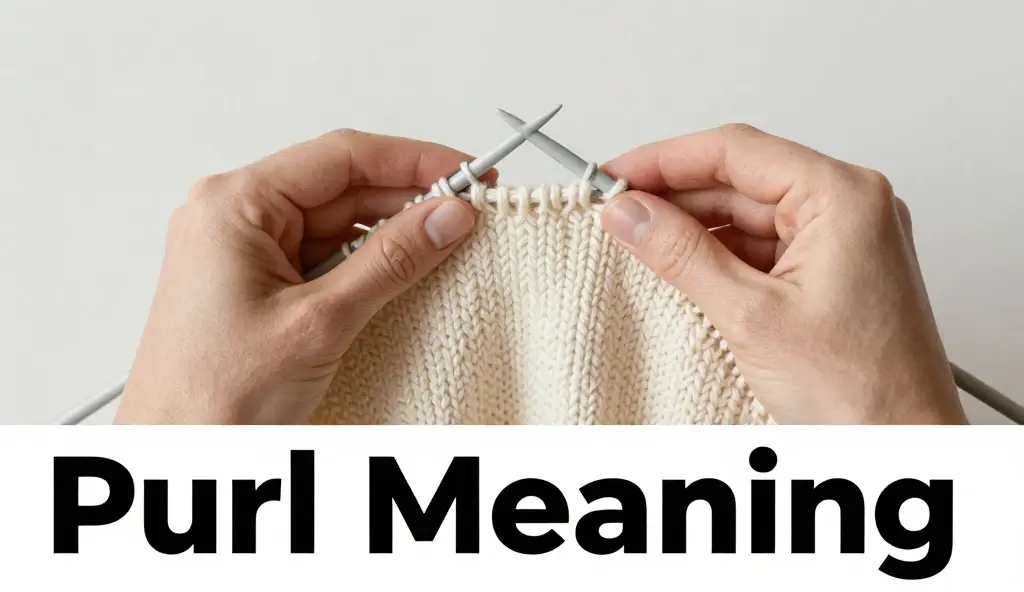
If you’ve come across the word purl, chances are you’ve encountered it in the world of knitting.
The term is one of the most fundamental concepts in knitting and is essential for creating countless patterns, textures, and fabrics. However, purl can also have meanings outside of knitting, including a literary definition related to the gentle sound of flowing water.
The purl meaning depends on context, but it most commonly refers to a basic knitting stitch that forms a textured pattern on fabric.
This guide explains the complete meaning of purl, its uses in knitting, pronunciation, origin, examples, and related terminology.
What Does Purl Mean?
In Knitting
A purl is one of the two basic knitting stitches, alongside the knit stitch.
When a knitter creates a purl stitch, the yarn is worked from the front of the fabric, producing a small horizontal bump on the finished material.
Simple Definition
A purl is a basic knitting stitch used to create texture and patterns in knitted fabric.
Purl Meaning in Knitting
Knitting is built on two fundamental stitches:
- Knit stitch
- Purl stitch
By combining these stitches in different ways, knitters can create:
- Scarves
- Sweaters
- Blankets
- Hats
- Socks
- Decorative patterns
The purl stitch is often considered the reverse of the knit stitch.
How a Purl Stitch Looks
A completed purl stitch appears as:
- A small horizontal bump
- A raised texture
- A ridged appearance
When viewed from the opposite side of the fabric, a purl stitch resembles a knit stitch.
This relationship between knit and purl stitches is the foundation of most knitting techniques.
Why Is the Purl Stitch Important?
The purl stitch helps knitters create:
Texture
Purl stitches add visual interest and depth.
Stretch
Certain stitch combinations improve flexibility.
Patterns
Many advanced knitting designs rely heavily on purl stitches.
Ribbing
Common ribbed fabrics use alternating knit and purl stitches.
Knit vs Purl
The two stitches are closely related.
| Knit Stitch | Purl Stitch |
| Yarn held at the back | Yarn held at the front |
| Smooth appearance | Raised bump appearance |
| Basic stitch | Reverse of knit stitch |
Most knitting projects use both stitches together.
Common Knitting Patterns Using Purl Stitches
Stockinette Stitch
- Knit on one side
- Purl on the opposite side
Creates a smooth fabric commonly used in sweaters.
Garter Stitch
- Knit every row or purl every row
Produces ridges throughout the fabric.
Rib Stitch
Alternating knit and purl stitches create stretchy fabric often used for:
- Cuffs
- Collars
- Hat brims
How to Use Purl as a Verb
Purl can also function as a verb.
Examples
- She learned to purl during her first knitting class.
- The beginner practiced purling for several hours.
- He can knit and purl confidently.
In these cases, purl refers to the act of making purl stitches.
Purl Meaning Outside of Knitting
Although less common today, purl also has a literary meaning.
Literary Definition
To flow, ripple, or murmur softly like a stream of water.
Example
The brook purled gently through the forest.
Writers often use this meaning in poetry and descriptive prose.
Origin of the Word Purl
The word has different historical roots depending on its usage.
Knitting Meaning
The knitting term developed from older textile and needlework vocabulary.
Literary Meaning
The water-related definition comes from older English words associated with flowing and rippling sounds.
Both meanings have been part of the English language for centuries.
Pronunciation of Purl
Purl is pronounced:
/pɜːrl/
It sounds like:
“perl”
Rhymes with:
- Pearl
- Curl
- Whirl
Common Examples of Purl
Knitting Examples
- The pattern requires two knit stitches and two purl stitches.
- She practiced purling before starting a sweater.
- Learning to purl is an important knitting skill.
Literary Examples
- The stream purled through the valley.
- Water purled softly over the rocks.
Synonyms of Purl
Knitting Context
There are no exact synonyms because purl refers to a specific stitch.
Literary Context
Possible synonyms include:
- Murmur
- Ripple
- Babble
- Flow
- Trickle
Common Mistakes About Purl
Thinking Purl Means Knit
False.
Although related, knit and purl are different stitches.
Assuming Purl Is Only a Noun
False.
It can be both a noun and a verb.
Forgetting the Literary Meaning
While rare today, purl can describe the sound or movement of flowing water.
Confusing Purl with Pearl
They sound alike but have different meanings and spellings.
Why Is the Purl Stitch So Important?
The purl stitch is essential because it allows knitters to create:
- Texture
- Stretch
- Decorative patterns
- Professional-looking garments
Without purl stitches, many popular knitting designs would not be possible.
Mastering the purl stitch is often considered a major milestone for beginner knitters.
Expert Insight
Knitting instructors often emphasize that learning the purl stitch unlocks a vast range of knitting possibilities. Together with the knit stitch, it forms the foundation of nearly every knitting technique, from simple scarves to intricate cable-knit sweaters. Even advanced knitters continue to rely on purl stitches throughout their work.
FAQs
Q1. What does “purl” mean?
A: A purl is a basic knitting stitch and one of the two fundamental stitches used in knitting.
Q2. Is “purl” a noun or a verb?
A: It can be both. As a noun, it refers to a stitch. As a verb, it means the action of making that stitch.
Q3. What is a purl stitch?
A: A purl stitch is a knitting technique that creates a raised horizontal bump on the fabric surface.
Q4. How is purl different from knit?
A: The purl stitch is essentially the reverse of the knit stitch, and both are used together to create patterns.
Q5. Why is the purl stitch important in knitting?
A: It helps create texture, elasticity, and more advanced knitting patterns.
Q6. How do you pronounce “purl”?
A: It is pronounced the same as “pearl.”
Q7. Can beginners learn the purl stitch easily?
A: Yes, it is one of the first essential stitches taught after learning the knit stitch.
Q8. What does “purl” mean in literature?
A: In literature, it can refer to the soft, gentle sound of flowing or bubbling water.
Q9. What is purling in knitting?
A: Purling refers to the process of creating purl stitches while knitting.
Q10. Is purl used outside knitting?
A: Yes, but it is less common today and mostly used in literary or descriptive contexts.
Q11. What knitting patterns use purl stitches?
A: Common patterns include ribbing, stockinette stitch, garter stitch, and many textured designs.
Q12. Is there an opposite of the purl stitch?
A: There is no exact opposite, but the knit stitch is considered its main counterpart.
Q13. Do all knitting projects use purl stitches?
A: Not always. Some simple projects may use only knit stitches.
Q14. Why does the purl stitch create texture?
A: Because it forms raised loops on the surface of the fabric, giving it a textured look.
Q15. Is “purl” an important knitting term?
A: Yes, it is one of the most essential terms in knitting and widely used in patterns.
Conclusion:
The purl meaning most commonly refers to a fundamental knitting stitch used to create texture, patterns, and structure in knitted fabric.
Along with the knit stitch, it forms the foundation of nearly all knitting projects.
Beyond knitting, purl can also describe the gentle murmur or ripple of flowing water in literary contexts.
Understanding the purl stitch is a key step for anyone learning the art of knitting.

A passionate content writer and meaning researcher specializing in word meanings, modern phrases, and inspirational quotes. Olivia creates easy-to-understand content for global readers.