
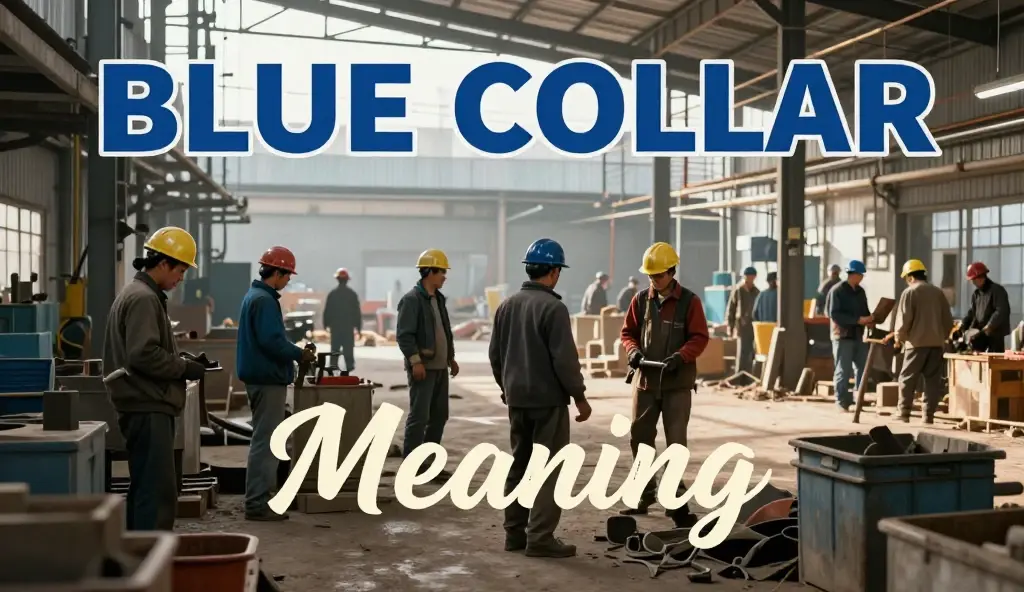
“Blue collar meaning” is a term for certain kinds of jobs.
It means people who do physical or hands-on work, like building houses, fixing machines, working in factories, or driving trucks.
These jobs often need training and skills, but not always a college degree.
Blue collar workers are very important because they help keep cities and daily life working.
This term helps us understand different types of jobs people do.
What Does Blue Collar Mean? (Simple Definition)
Blue Collar Meaning:
Blue-collar workers are people who do physical or manual work for a living.
Easy explanation:
- Work with hands or machinery
- Practical, skill-based jobs
- Often paid hourly or daily wages
- Work done outside offices
Origin of the Term “Blue Collar”
The term blue collar comes from the early 20th century in the United States.
Why “blue” collar?
- Workers in manual labor jobs often wore durable blue denim or blue uniforms
- Blue clothing helped hide dirt, grease, and stains from physical work
So the term “blue collar” became associated with:
Hard-working manual laborers in physical industries
Blue Collar Jobs (Common Examples)
Here are some typical blue collar professions:
Construction & Skilled Trades
- Electricians
- Plumbers
- Carpenters
- Welders
- Masons
Manufacturing & Industry
- Factory workers
- Machine operators
- Assembly line workers
Transportation & Logistics
- Truck drivers
- Delivery drivers
- Warehouse workers
Maintenance & Services
- Mechanics
- Technicians
- Cleaners
- Security staff
Blue Collar Meaning in Modern Context
Today, blue collar work is no longer seen as “low status.” In fact, it is highly respected because:
- Many jobs pay very well
- Skilled trades are in high demand
- No expensive university degree required
- Job stability in essential industries
Modern view:
Blue collar = skilled, essential workforce that keeps society running
Blue Collar vs White Collar (Key Difference)
| Blue Collar | White Collar |
| Manual labor | Office-based work |
| Physical work | Mental/administrative work |
| Trades & machinery | Corporate & management roles |
| Hourly wage often | Salary-based income |
| Construction, repair, transport | Finance, IT, marketing |
Collar Blue Meaning in Sociology
In sociology, “blue collar” refers to:
- Working-class individuals
- Industrial labor workforce
- People in physically demanding jobs
It is often discussed alongside:
- Social class structure
- Income levels
- Education differences
Skills Needed for Blue Collar Jobs
Blue collar work often requires:
- Technical training
- Apprenticeships
- On-the-job experience
- Problem-solving skills
- Physical strength and stamina
- Safety awareness
Advantages of Blue Collar Jobs
1. High Demand
Skilled workers are needed everywhere.
2. Good Income Potential
Many trades earn strong salaries.
3. No Degree Required
Many jobs focus on skills, not formal education.
4. Job Security
Essential services cannot be easily replaced.
Challenges of Blue Collar Work
- Physically demanding
- Outdoor or harsh environments
- Risk of injury in some jobs
- Long working hours in certain industries
Blue Collar Meaning in Pop Culture
The term is often used in:
- Movies showing working-class life
- Sports culture
- Music (especially country and rock)
- Social discussions about class and economy
It often represents:
Hard work, resilience, and real-world labor
Examples of Blue Collar Sentences
- “My father is a blue-collar worker in construction.”
- “Blue-collar jobs are essential for infrastructure development.”
- “He switched from an office job to a blue-collar career as an electrician.”
Blue Collar vs Pink Collar (Extra Insight)
| Type | Meaning |
| Blue collar | Manual labor jobs |
| White collar | Office/corporate jobs |
| Pink collar | Care/service jobs (nursing, teaching, etc.) |
Common Misconceptions
1. “Blue collar means low-skilled”
❌ False — many blue collar jobs require high skill and certification.
2. “Blue collar jobs don’t pay well”
❌ False — electricians, plumbers, and mechanics can earn high incomes.
3. “It’s less important than office work”
❌ False — society depends heavily on blue collar industries.
FAQs
Q1. What is blue collar meaning in simple words?
A: It means jobs that involve manual or physical work.
Q2. What are examples of blue collar jobs?
A: Electricians, plumbers, drivers, factory workers.
Q3. Why is it called blue collar?
A: Because workers traditionally wore blue uniforms.
Q4. Is blue collar work hard?
A: Yes, it is physically demanding.
Q5. Do blue collar jobs pay well?
A: Many skilled trades can pay very well.
Q6. Is construction a blue collar job?
A: Yes, it is a classic blue collar industry.
Q7. What is the opposite of blue collar?
A: White collar jobs.
Q8. Is mechanic a blue collar job?
A: Yes, mechanics are blue collar workers.
Q9. Do blue collar jobs require a degree?
A: Not always; skills or vocational training are often enough.
Q10. Is truck driving blue collar?
A: Yes, it is a transportation-based blue collar job.
Conclusion:
“Blue collar meaning” is a word used for jobs where people do physical work.
Blue collar workers help build and fix things like houses, roads, and machines.
They also work in factories and transport goods.
These jobs are very important because they help society run smoothly.
Today, blue collar jobs are respected and needed.
Many people in these jobs are skilled and earn good money.
This word helps us understand different kinds of work people do.

Logan is a professional blogger and researcher passionate about internet culture, digital language trends, and modern communication meanings.