The word “resonate” means something that feels strong and important to you.
It is used when something makes you feel connected in your heart or mind.
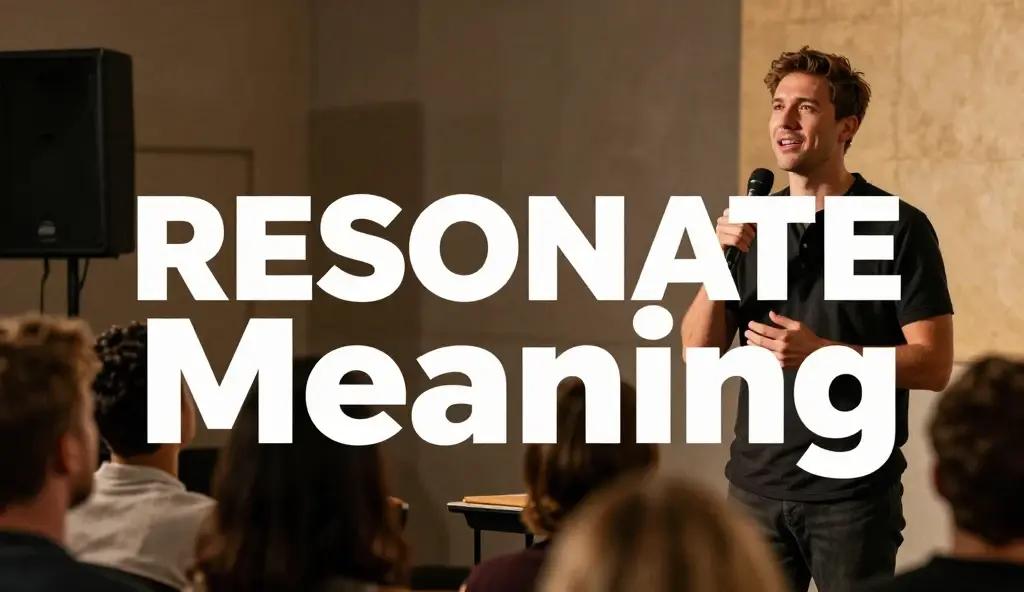
For example, a speech can feel like it is talking about your life.
A song can make you feel happy or sad.
An idea can match what you believe.
When something resonates, it means it feels special to you and you understand it deeply.
This word helps us know why some things feel nice, meaningful, or important to us.
What Does Resonate Mean? (Simple Definition)
Resonate Meaning (Basic Definition)
Resonate means to produce a strong emotional response or to be deeply meaningful or relatable to someone.
Simple Explanation
Resonate = to feel connected or strongly affected by something
Two Main Meanings of Resonate
1. Emotional Meaning (Most Common Today)
Something that “resonates” with you feels personally meaningful.
Example:
- “Her story really resonated with me.”
👉 Meaning: I relate to her story emotionally.
2. Literal Meaning (Sound / Physics)
To produce a deep, strong, or echoing sound.
Example:
- “The sound of thunder resonated across the mountains.”
👉 Meaning: The sound echoed loudly.
Origin of the Word “Resonate”
The word resonate comes from the Latin word:
“resonare” meaning to sound again
It entered English through scientific and musical terminology, originally describing sound vibrations.
Over time, its meaning expanded into emotional and metaphorical usage in psychology, communication, and everyday language.
Today, “resonate” is widely used in:
- Business communication
- Motivational speaking
- Social media
- Education
- Personal development
How to Pronounce Resonate
Resonate is pronounced as:
REZ-uh-nayt
Breakdown:
- REZ → strong start
- uh → soft middle
- nayt → ending sound
Resonate Meaning in Different Contexts
The meaning of “resonate” changes depending on context.
1. Emotional Context (Most Common)
When something connects deeply with feelings.
Examples:
- “That movie really resonated with me.”
- “Her words resonated with my struggles.”
- “This message resonates with young people.”
2. Communication Context
Used in speeches, writing, and marketing.
Examples:
- “The campaign resonated with customers.”
- “His message resonates with the audience.”
3. Music and Sound Context
Used for sound vibrations.
Examples:
- “The guitar resonates beautifully in this room.”
- “The voice resonated through the hall.”
4. Psychological Context
Used in emotional psychology.
Examples:
- “Certain memories resonate deeply in the mind.”
- “Trauma often resonates long after the event.”
Resonate Meaning in Sentences (Real Examples)
Here are natural, real-world examples:
- “This quote really resonates with my life.”
- “The speech resonated with millions of people.”
- “Her story resonates with anyone who has faced failure.”
- “The music resonates deeply in my heart.”
- “That idea doesn’t resonate with me.”
- “His message resonates across cultures.”
Why “Resonate” Is So Popular in Modern Language
The word “resonate” has become extremely popular in:
- Business branding
- Social media captions
- Motivational speaking
- Self-help content
- Personal storytelling
Reasons for popularity:
1. Emotional depth
It expresses feelings better than simple words like “like” or “agree.”
2. Professional tone
It sounds smart, polished, and intellectual.
3. Versatility
It works in emotional, academic, and business contexts.
Resonate vs Similar Words (Important Differences)
Many people confuse “resonate” with similar words. Let’s clarify:
1. Resonate vs Relate
- Resonate: deep emotional connection
- Relate: understanding or identifying with something
Example:
- “I relate to your story.” (I understand it)
- “Your story resonates with me.” (I feel it deeply)
2. Resonate vs Agree
- Agree: logical acceptance
- Resonate: emotional connection
3. Resonate vs Connect
- Connect: general link
- Resonate: emotional or meaningful impact
4. Resonate vs Inspire
- Inspire: motivates action
- Resonate: creates emotional understanding
Synonyms of Resonate
- Connect
- Relate
- Echo
- Strike a chord
- Move
- Affect
- Touch emotionally
- Ring true
Antonyms of Resonate
- Disconnect
- Confuse
- Ignore
- Disengage
- Fail to connect
Resonate in Real-Life Situations
1. Social Media
- “This post really resonates with me.”
2. Music
- “This song resonates deeply with my emotions.”
3. Education
- “This lesson resonates with students’ real experiences.”
4. Business
- “Our brand message resonates with customers.”
5. Personal Life
- “His advice resonated with my situation.”
Psychology Behind “Resonance”
Why do some things resonate and others don’t?
1. Personal Experience
We resonate with things that match our life.
2. Emotional Memory
Past experiences trigger emotional responses.
3. Identity Connection
We resonate with messages that reflect who we are.
4. Storytelling Impact
Stories create stronger resonance than facts.
Resonate in Literature and Writing
Writers use “resonate” to:
- Create emotional depth
- Build character connection
- Strengthen storytelling impact
- Engage readers
Example in literature:
- “The theme of loss resonates throughout the novel.”
Business and Marketing Use of Resonate
In marketing, “resonate” is a powerful keyword.
Why marketers use it:
- Emotional branding
- Audience engagement
- Message clarity
- Customer connection
Example:
- “Our campaign resonates with modern consumers.”
Common Mistakes with “Resonate”
1. Overusing it
Too much usage weakens impact.
2. Using it without emotion
It should involve feeling, not just logic.
3. Confusing it with agree
Resonate is emotional, not logical.
Expert Insight: Why “Resonate” Matters in Communication
From a linguistic and psychological perspective, “resonate” is powerful because:
- It captures emotional intelligence
- It enhances communication depth
- It improves storytelling effectiveness
- It reflects human emotional processing
In modern digital communication, resonance determines whether content becomes viral or ignored.
Quick Summary
- Resonate means to deeply connect emotionally or to echo strongly
- It is widely used in emotional, business, and creative contexts
- It comes from Latin meaning “to sound again”
- It is more emotional than “relate” or “agree”
FAQs
Q1. What is the simple meaning of resonate?
A: Resonate means to connect deeply or feel meaningful.
Q2. What does resonate mean in slang?
A: It means something feels relatable or emotionally powerful.
Q3. Is resonate positive or negative?
A: Usually positive, but it depends on context.
Q4. What is an example of resonate?
A: “This story resonates with me.”
Q5. What does resonate mean in music?
A: To produce a deep or echoing sound.
Q6. What is the opposite of resonate?
A: Disconnect or fail to connect.
Q7. What does emotionally resonate mean?
A: It means something strongly touches your feelings.
Q8. Can ideas resonate?
A: Yes, ideas can strongly connect with people.
Q9. What is a synonym for resonate?
A: Relate, connect, or strike a chord.
Q10. How do you use resonate in a sentence?
A: “Her words resonate with me.”
Q11. What does resonate with audience mean?
A: It means the audience strongly connects with the message.
Q12. Is resonate formal or informal?
A: It is formal but also commonly used in everyday speech.
Q13. What is cultural resonance?
A: When ideas connect across different cultures.
Q14. Why do things resonate with people?
A: Because of shared experiences or emotions.
Q15. Is resonate used in business?
A: Yes, especially in marketing and branding.
Conclusion:
The word resonate means something feels important or meaningful to you.
It can happen when you hear a song, read a story, or listen to someone’s words.
When something resonates with you, it makes you think or feel something special.
Learning this word can help you speak and write better.
It also helps you understand how people connect with ideas and feelings.
Today, there is a lot of information everywhere.
The things people remember most are the things that resonate with them.

James is an experienced SEO content creator who writes about trending meanings, cultural phrases, and educational topics with clarity and accuracy.